The Background of RTE
When India became independent in 1947, it gained political freedom, but a large majority of its population did not have access to basic education. Illiteracy limited people’s ability to earn livelihoods, understand their rights, and participate meaningfully in democracy.
For several decades after independence, the government expanded public education through government schools and universities. However, over time, a clear divide emerged:
- Private schools offered better infrastructure and learning outcomes but were affordable only to a small section of society.
- Government schools, attended largely by children from economically weaker backgrounds, often struggled with limited resources.
This created unequal access to quality education, even though education is essential for social mobility and equality.
Recognizing this gap, the Supreme Court of India, in the Unni Krishnan judgment (1993), held that the Right to Life under Article 21 of the Constitution is incomplete without the right to education. This understanding led to the 86th Constitutional Amendment (2002), which inserted Article 21A, making free and compulsory education for children a Fundamental Right.To implement Article 21A in practice, Parliament enacted the Right to Education (RTE) Act, 2009.
What is RTE 12(1)(c)?
One of the most important provisions of the RTE Act is Section 12(1)(c).
It requires private unaided schools to reserve 25% of seats at the entry level for children from:
- Economically Weaker Sections (EWS)
- Disadvantaged Groups (DG)
The government reimburses these schools for the cost of education of these students.
Why Section 12(1)(c) Matters
Section 12(1)(c) was introduced to address unequal access to quality education. It ensures that children from disadvantaged backgrounds are not limited only to under-resourced schools.
This provision aims to:
- Promote social inclusion by enabling children from different socio-economic backgrounds to study together.
- Reduce inequality of opportunity by giving underprivileged children access to the same quality of education as their peers.
- Strengthen long-term outcomes in employment, civic participation, and social mobility.
Section 12(1)(c) is not just an admission rule. It is a policy tool designed to ensure that the constitutional promise of equality and dignity is reflected in everyday schooling experiences.
The RTE–DPG–MIS platform exists to operationalize this provision at scale, ensuring transparent implementation, accountability, and effective coordination between schools, administrators, and the government.
Introduction to RTE-DPG-MIS
RTE-DPG-MIS is a centralized digital system developed to support and monitor admissions under the Right to Education (RTE) Act. The platform is designed to help parents, private unaided schools, and education department officials at State, District and Block levels carry out RTE admissions in a simple, transparent and standardized manner.
This document is prepared for non-technical users. It explains the purpose of the system, how the platform is used, and how different users interact with it during the RTE admission process.
The main objectives of RTE-DPG-MIS are:
- to simplify the RTE admission process for parents and schools,
- to ensure fair and transparent seat allocation,
- to support proper verification and admission workflows, and
- to enable effective monitoring and reporting by government authorities.
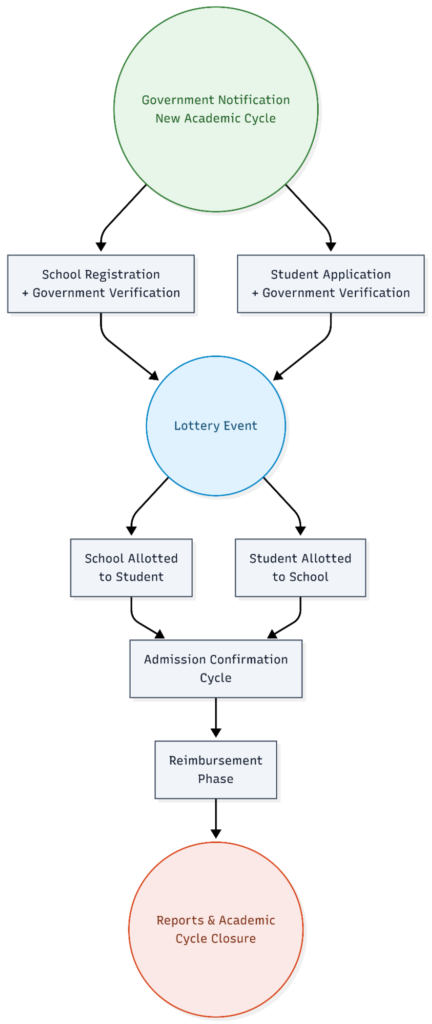
The platform replaces manual and paper-based processes with a single digital workflow. All important activities such as applications, lottery allocation, verification, admissions and reimbursements are recorded in the system and can be tracked by authorized users.
This system is intended for:
- Parents or guardians applying for RTE admission for their children
- Private school administrators
- Block-level education officers
- District-level education officers
- State-level education administrators
The purpose of this document is to help all users clearly understand how the platform works and how to complete their tasks correctly and on time, without needing any technical knowledge.